Can Am Commander Only One Front Tire Turns
From time to time, your ATV does not behave the way y'all want it to. Zippo bang-up lasts forever, right? I of the most mutual issues y'all may feel is that your bike of a sudden or gradually starts pulling or drifting to the left or correct. If you are lucky, there may exist an piece of cake explanation for your trouble. Permit's have a wait at some of the almost common reasons an ATV pulls to either side and, of course, how to fix them.
The most common reason why an ATV pulls either to the left or right is a departure in the front end wheels' circumference due to different air pressure. Wear or damage to the various components in the undercarriage of the quad can as well issue in these kinds of problems and may crave replacement. If this doesn't resolve your problems, the forepart bicycle alignment may be out of order and needs to be addressed.
How exercise you place the issue that is causing bug on your ATV?
As you've probably understood by now, there is not just one single reason why this happens. To find the bodily reason why your ATV is wandering off into the ditch when you want to go straight, you lot demand to do some troubleshooting.
Although I have no solid statistics to prove what underlying crusade happens most frequently, I recommend you lot follow the checkpoints below by order. I start with the easiest to check problems and should be examined before you start spending time and money on more uncommon and potentially more complex solutions.
Checkpoint ane: A divergence in wheel circumference
In my experience, the well-nigh common reason, and definitely the nearly straightforward issue to bank check and fix, is the different circumference of the front wheels on either side.
Basically, this means that for each time the wheels turn, ane wheel drives a slightly longer or shorter distance than the other. This will well-nigh certainly brand your wheel pull to the side, which has the smallest circumference wheel.
But both the wheels are identical, you lot might ask, and they have been in use for the aforementioned amount of time and mileage. How can this even be an effect?
The most likely cause: Different tire pressure in the front tires
ATV tires are relatively soft and flexible, so they basically act like balloons when you put air into them. Although not as visible equally on the birthday blazon, they still expand quite a bit when inflated with more air.
More air equals a bigger tire with a larger circumference. If the ATV pulls to the right, the front right tire pressure level might exist as well depression. If it pulls to the left, the same applies to the left tire.
What you need to do, is to make certain both tires are prepare with the correct factory specific tire pressure or to your personal preference for the intended use. Use a good tire pressure guess to check your levels.
Most ATV brands come up with one in the tool-kit. If you can't detect it I strongly recommend getting i as soon equally you tin, they are not expensive. Just a two to 3 pounds difference between the tires can be enough to create an consequence.
You lot should cheque both front and rear tires. Although uneven pressure in the rear tires is less probable to crusade your pulling effect, information technology's worth controlling them when you lot are at it. Information technology's not good if they don't have the same circumstance, as that will cause them to "fight" each other and may cause premature rear diff vesture.
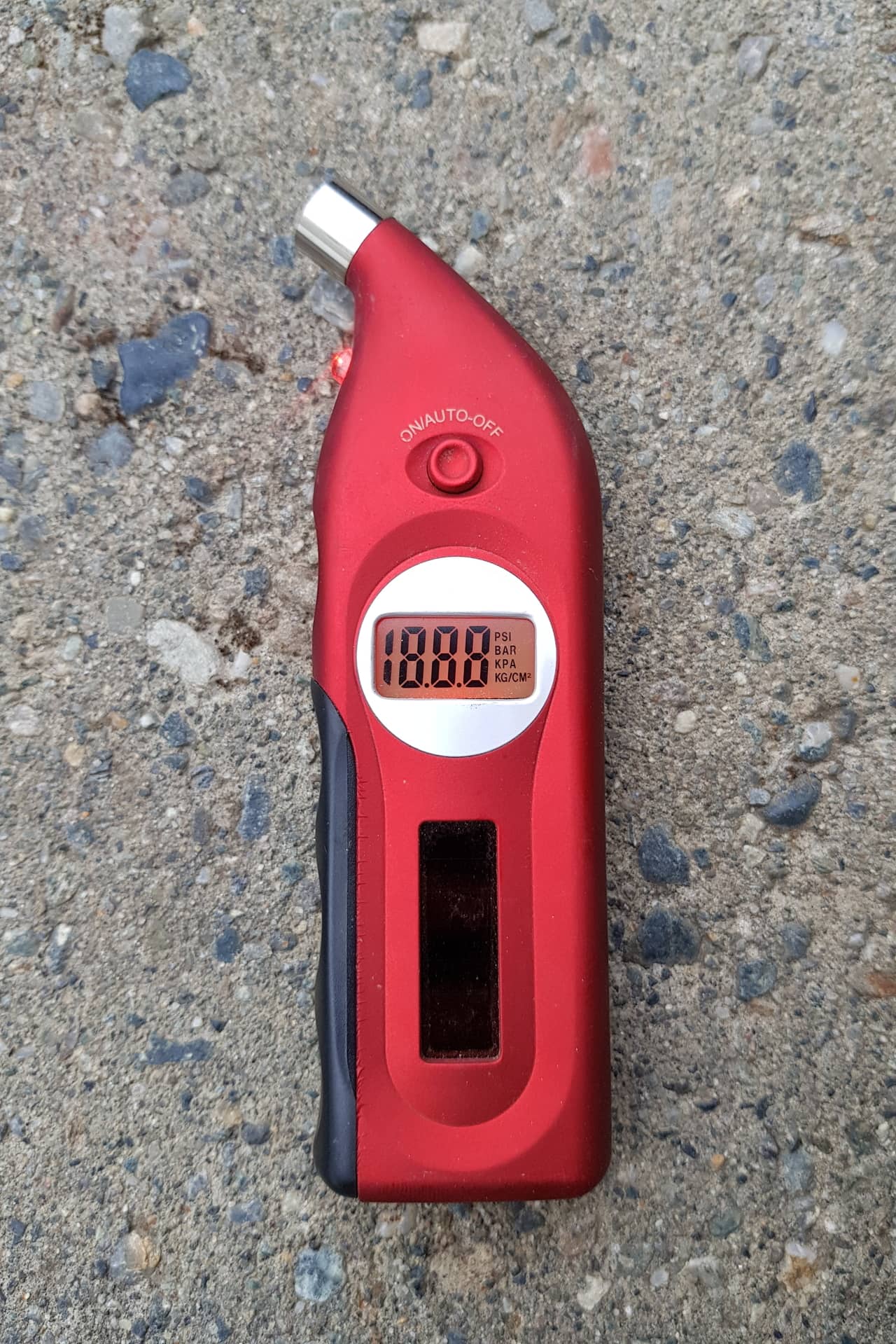 I keep this inexpensive digital one in my tool kit at all times, and the accuracy is good enough for my use.
Caution! Never exceed the maximum tire pressure, usually written on the side of the tire.
If you are not sure what pressure is safe or optimal for your machine, please refer to your user manual.
Notation that at that place might be different pressure ratings for the forepart and the rear tires. What is of import in this case is that both front tires accept identical pressure, and as well, both rear tires read the same levels.
Now you can find a record measure or a piece of string to measure the circumference—Jack upwards the quad for proper admission. If you use the cord, you just put a marker when you lot mensurate ane side, and so the other side should be identical. If they are the same, yous are practiced to get!
Hither is some other easy method yous can try to cheque if the circumference the same: Place your ATV on a level, smoothen ground, and with a piece of chalk, brand a mark on the sidewall of each front end tire at the very bottom.
The wheels should be pointing straight forward, and the ATV should be in neutral. Then push the bike forward until the tire has made ii or three full turns, and the mark you merely made on the tire is back at the lesser where it started. Pay attention to but ane of the tires when doing this. And so take a wait at the mark on the reverse tire. Ideally, this should as well still be at the very lesser. If this is not the instance, the circumference is not the same as on the other tire.
If the ATV is pulling to the correct, the right tire probable has the smaller circumference, and if the ATV is pulling to the left, the left tire is probable the smaller ane.
What if the tire circumference is not the same using right tire pressure?
It's of import to know that fifty-fifty if both tires are at the same pressure, the circumference is not necessarily the aforementioned.
While this is generally more truthful for bias-ply tires than radials, the tire dimension will sometimes exist altered over time, only considering of treating them differently. If you at some time accept put more tire pressure in one of the tires than you usually use, this may have stretched the tire and contradistinct the circumference past as much as a couple of inches. This may happen even without exceeding the maximum tire pressure.
You tin try to correct this to put nearly 90% of the maximum tire pressure in both tires and leave them for a couple of days. I don't see the need to become all the way up to maximum pressure, as x% beneath maximum is still far over normal riding force per unit area and should have the aforementioned effect.
Doing this procedure may stretch the tires evenly. And so you should adapt the pressure level back downwardly to your preferred riding pressure and recheck the circumference.
If this does not make the tires the same size with identical tire pressure, y'all can inflate the smallest tire slightly more than the other until the circumference is the aforementioned. Then, the side by side time you buy new tires, y'all remember to never put more air in ane of them than the other!
But remember, and this can not exist said besides many times: Never exceed the maximum rated tire force per unit area as an exploding tire may exist fatal, even with lower pressure levels similar ATV tires usually should have.
Checkpoint ii: Check for clothing in the rod ends, ball joints, bushings, and bearings
For this step, yous need to commencement past jacking up your quad so that all four wheels are off the ground simultaneously. In that location are many ways y'all tin can do this; but make certain the cycle is stable.
I recommend that you discover a hard level surface like a concrete floor and apply a skillful quality jack. I similar placing a couple of wooden blocks under a flat spot in the center of the quad, one in front end and one in back.
If yous like maintaining your ATV yourself and have to lift information technology quite ofttimes, it may be well-spent coin to get a purpose-made ATV/motorcycle jack. But it is not mandatory for this inspection.
Yous desire to make sure yous don't have whatever free play in the tie rods or the A-arms. Just catch them and feel past pulling in unlike directions. This may happen due to clothing over time or bolts coming undone/loose.
Then meet if all the bushings are securely fastened and non loose or worn in any way. The steering column bushing usually wears over time. The same goes for the ball joints on the tie end rods.
Tighten any loose bolts or replace worn parts. Worn components can soon intermission, so it's never a waste matter to supervene upon them, even if they are not why you ATV pulls to the side.
Merely remember that an ATV's undercarriage is non entirely free of play even when the car is brand new. Some modest play may be perfectly normal and doesn't necessarily mean you lot take to supervene upon any parts.
You should besides check for any wear in the cycle bearings or the bearings in the axle carrier. For the wheels, place on hand on summit of the tire and on on the lesser and so endeavor to wobble it back and along to see if there is any play. For the carrier, take hold of the axle on both sides and check for play. Again I have to mention that even on a make new bike, I have experienced just a pocket-sized play when doing this exam. Then you lot shouldn't expect it to exist 100% tight and free of play!
Terminate this indicate by greasing your undercarriage if your ATV has this option. Your user'due south manual will requite good instructions on what components should be addressed with the grease press. Usually, bushings and bearings, although some machines have sealed bearings that exercise not crave service.
This ofttimes neglected maintenance is cheap and will greatly prolong your components' life and prevent h2o from entering with rust development as a result.
Checkpoint three: Check for a aptitude or damaged undercarriage
Visually audit the undercarriage components to identify bent or damaged parts.
The A-artillery are particularly decumbent to bending if yous hit a stump or a stone while going off-route. The «fast-growing» trees that seem to pop up suddenly just in forepart of the ATV when you ride are the worst!
The A-arms are actually designed to be the part that breaks first to avert damaging components that are harder or impossible to repair, similar the ATV frame. But it is non ever easy to see if they are bent or not. Some even come with a curve from the factory.
My best tip is to try to find an bending to compare them to the tie rods. If they are parallel on one side but not on the other, the arm is probable aptitude. This method is much easier on a snowmobile where you can stand up on tiptop of your auto and aim down on both A-arms at the same fourth dimension to compare.
Also, check the shocks for whatsoever visual damage. If the ATV was tipped over, the steering cavalcade and/or tie rods could be damaged. If the bolts on your steering cavalcade make contact with nearby components at a total turn, it is probable bent. Steering hoops may too exist bent, depending on how bad the rollover was.
Checkpoint three: checking the diffs and brakes
While your ATV is nevertheless jacked up, you may likewise check if your diffs are healthy. If they are damaged, the power distribution might be off, sending all the power to ane of the wheels, naturally causing a pull to 1 side.
It's piece of cake to test this. With the iv×4 engaged and the ATV in gear, try spinning i of the forepart wheels; if the other cycle spins freely in the opposite management, then your diff is likely okay. Also, try this with the 4×iv disengaged.
Then put the bike in neutral and cheque that all four wheels spin freely with no restriction elevate or grinding sounds. If the restriction is dragging on either side, you should address this.
Checkpoint four: Brand sure your toe alignment is on track
The reason why I didn't accost misalignment before in this step is quite uncomplicated. I don't want you to autumn for the temptation to start making adjustments to the bicycle before y'all are sure that none of the above reasons cause your troubles.
Fifty-fifty tho making adjustments may better the situation; even if your problem is one of the to a higher place, you are non addressing the real issue; yous are only compensating without fixing what is really making your machine pull to the side.
Your rear tires should generally always exist parallel to each other and perpendicular to the ground. The front tires, on the other manus, should be leaning slightly toward the ATV. This is called camber. They should also be angled slightly inward (toe-in) or outward (toe-out) depending on your intended utilize. Some riders even prefer parallel front tires.
On stock ATV suspension, you usually don't have the option to arrange the caster and slant as you may accept on a car. These are prepare at the factory and should normally not exist an effect. This basically leaves merely the ability to adjust the toe-in on your wheel.
Near manufacturers strongly advise against owners making this kind of aligning on their machines of their ain. So in this article, I volition not be addressing the alignment process itself; this volition come in a separate commodity later.
Merely what you definitely can and should do, is to command if the toe alignment is set according to factory specifications. Your user manual usually has brand-specific instructions and recommended toe-in specs. The recommended specs vary depending on the intended use of the automobile.
For sport type purposes, it is recommended to take a slight toe-in. This means that the altitude between the rims' front end is slightly shorter than at the back, usually no more than than vi-12mm. This gives a more precise and responsive steering response.
In racing, it is common to prefer a parallel aligning of the front end wheels to reduce drag and increase performance.
For utility ATVs, on the other manus, information technology is recommended with a slight toe-out. This means that the distance betwixt the rims' front is slightly longer than at the back, usually no more than half-dozen-12mm. This setup makes the bike more stable, especially when carrying heavy cargo on the front rack.
Some riders use their utility ATV mostly for trail riding and prefer a slight toe-in for better handling.
This is how you check the tire alignment on any ATV
- Place your ATV on a hard level surface like a garage floor.
- Place the handlebars as if going directly ahead. Visual alignment is usually accurate enough. Optional, merely important if you programme on making any adjustments yourself: Fasten each side of the handlebar to a stock-still location at the back of the bike using tie-downward straps to make sure it doesn't move out of position.
- Necktie a cord between 2 stands and place the stands on one side of the ATV so that the string is parallel with and just barely touching the rear tire.
- So measure the distance between the string and your rim at both the front and back of your front bike. The difference between these ii measurements should be the same on both sides of your ATV and co-ordinate to factory recommendations.
If you don't have a string and stand up available, or if you want more accuracy, employ this method:
- Measure the distance from the ground to the wheel's center to notice half the tire'due south summit.
- Use this measurement to mark off four measuring points on the inside of the wheels. You'll demand ane mar in forepart of the axle and one behind the axle, both at the same distance from the ground. I prefer placing the marks on the rim and not the tire for the best accurateness.
- Then measure the altitude between the two front marks and then the rear marks. Compare the measurements up against your desired specifications.
Checkpoint iv, low-quality tires
If you lot nonetheless have stock tires on your quad, they are not always the all-time quality.
They may seem perfectly fine, but manufacturers often cull inexpensive tires to continue the bicycle'due south price as low as possible. Also, they know that changing to better tires is ofttimes one of the offset upgrades people exercise to their ATV, so no need to intermission the budget on tires that will exist replaced anyway.
Upgrading to a decent aftermarket tire may vastly meliorate your auto's riding performance and may besides eliminate whatsoever bug you take with pulling to the side.
Until contempo years, well-nigh all ATV tires were bias-ply tires. Continue in listen that this mode of tires is non ideal for pavement use. They generally get warmer when you ride and are less resistant to wear.
If you lot have any abnormal or uneven article of clothing in your tires, this will most likely affect the ability to go in a straight line on a paved road. If you ride mainly on hard, polish surfaces, you may want to consider investing in some radial tires instead.
When buying new tires, you can test them when they are brand new with the method in checkpoint one. If they don't have close to identical circumference when tire force per unit area is the same, I would take them back to the dealer and ask for a new prepare or consider a different make and model.
Source: https://boostatv.com/pull-left-or-right/
0 Response to "Can Am Commander Only One Front Tire Turns"
Post a Comment