The Wpa Formed One of the Largest Federal Programs for the Support of the Arts
 | |
| Agency overview | |
|---|---|
| Formed | May half dozen, 1935 (1935-05-06) |
| Preceding |
|
| Dissolved | June 30, 1943 |
| Headquarters | New York Urban center |
| Employees | 8.v million 1935–1943 three.3 million in November 1938 (tiptop) |
| Annual budget | $1.3 billion (1935) |
| Key document |
|
The Works Progress Administration (WPA; renamed in 1939 as the Work Projects Administration) was an American New Bargain agency, that employed millions of jobseekers (mostly men who were not formally educated) to carry out public works projects,[1] including the construction of public buildings and roads. It was set up on May six, 1935, by presidential club, as a primal office of the Second New Deal.
The WPA'south first appropriation in 1935 was $4.ix billion (about $fifteen dollars per person in the U.S.)(about half dozen.7 percent of the 1935 GDP).[2] Headed by Harry Hopkins, the WPA supplied paid jobs to the unemployed during the Great Low in the United states of america, while building upward the public infrastructure of the US, such as parks, schools, and roads. Most of the jobs were in structure, building more than 620,000 miles (i,000,000 km) of streets and over 10,000 bridges, in add-on to many airports and much housing. The largest unmarried projection of the WPA was the Tennessee Valley Say-so.
At its peak in 1938, information technology supplied paid jobs for iii million unemployed men and women, also as youth in a dissever division, the National Youth Administration. Between 1935 and 1943, the WPA employed viii.5 million people (nearly half the population of New York).[3] Hourly wages were typically kept well below industry standards.[4] : 196 Full employment, which was reached in 1942 and appeared as a long-term national goal around 1944, was not the goal of the WPA; rather, it tried to supply ane paid job for all families in which the breadwinner suffered long-term unemployment.[5] : 64, 184
In one of its most famous projects, Federal Projection Number One, the WPA employed musicians, artists, writers, actors and directors in arts, drama, media, and literacy projects.[i] The five projects dedicated to these were: the Federal Writers' Projection (FWP), the Historical Records Survey (HRS), the Federal Theatre Project (FTP), the Federal Music Project (FMP), and the Federal Art Project (FAP). In the Historical Records Survey, for example, many sometime slaves in the Southward were interviewed; these documents are of immense importance to American history. Theater and music groups toured throughout the United states of america and gave more than 225,000 performances. Archaeological investigations under the WPA were influential in the rediscovery of pre-Columbian Native American cultures, and the development of professional archæology in the Us.
The WPA was a federal program that ran its ain projects in cooperation with land and local governments, which supplied 10–thirty% of the costs. Usually, the local sponsor provided land and often trucks and supplies, with the WPA responsible for wages (and for the salaries of supervisors, who were non on relief). WPA sometimes took over land and local relief programs that had originated in the Reconstruction Finance Corporation (RFC) or Federal Emergency Relief Administration programs (FERA).[5] : 63 It was liquidated on June 30, 1943, considering of low unemployment during World War II. Robert D. Leininger asserted: "millions of people needed subsistence incomes. Work relief was preferred over public assistance (the dole) because information technology maintained self-respect, reinforced the work ethic, and kept skills precipitous."[6] : 228
Establishment [edit]
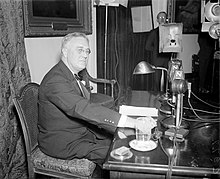
On May 6, 1935, FDR issued executive order 7034, establishing the Works Progress Administration.[seven] [eight] The WPA superseded the work of the Federal Emergency Relief Administration, which was dissolved. Directly relief assistance was permanently replaced past a national work relief plan—a major public works programme directed by the WPA.[9]
The WPA was largely shaped by Harry Hopkins, supervisor of the Federal Emergency Relief Administration and close adviser to Roosevelt. Both Roosevelt and Hopkins believed that the road to economical recovery and the lessened importance of the dole would exist in employment programs such every bit the WPA.[5] : 56–57 Hallie Flanagan, national director of the Federal Theatre Project, wrote that "for the first time in the relief experiments of this country the preservation of the skill of the worker, and hence the preservation of his self-respect, became important."[10] : 17
The WPA was organized into the following divisions:
- The Division of Applied science and Construction, which planned and supervised construction projects including airports, dams, highways and sanitation systems.[11]
- The Division of Professional person and Service Projects (chosen the Division of Women's and Professional Projects in 1937), which was responsible for white-collar projects including teaching programs, recreation programs, and the arts projects. Information technology was later named the Sectionalization of Customs Service Programs and the Service Division.[12]
- The Division of Finance.[13]
- The Segmentation of Information.[fourteen]
- The Partitioning of Investigation, which succeeded a comparable division at FERA and investigated fraud, misappropriation of funds and disloyalty.[15]
- The Division of Statistics, also known equally the Division of Social Research.[sixteen]
- The Project Command Division, which candy project applications.[17]
- Other divisions including the Employment, Management, Safety, Supply, and Training and Reemployment.[xviii]
Employment [edit]

WPA road development projection
These ordinary men and women proved to be extraordinary across all expectation. They were golden threads woven in the national cloth. In this, they shamed the political philosophy that discounted their value and rewarded the ane that placed its faith in them, thus fulfilling the founding vision of a government past and for its people. All its people.
—Nick Taylor, American-Made: The Enduring Legacy of the WPA [xix] : 530
The goal of the WPA was to utilise nigh of the unemployed people on relief until the economic system recovered. Harry Hopkins testified to Congress in January 1935 why he set up the number at 3.five million, using Federal Emergency Relief Administration data. Estimating costs at $1,200 per worker per year ($23,717 in present-twenty-four hour period terms[twenty]), he asked for and received $4 billion ($79.i billion in nowadays-twenty-four hours terms[20]). Many women were employed, but they were few compared to men.
In 1935 there were 20 meg people on relief in the United States. Of these, 8.3 million were children under sixteen years of age; iii.8 million were persons betwixt the ages of 16 and 65 who were non working or seeking work. These included housewives, students in school, and incapacitated persons. Another 750,000 were person historic period 65 or over.[21] : 562 Thus, of the total of 20 one thousand thousand persons then receiving relief, 13 million were non considered eligible for employment. This left a total of 7 million presumably employable persons between the ages of 16 and 65 inclusive. Of these, however, 1.65 meg were said to be farm operators or persons who had some non-relief employment, while another 350,000 were, despite the fact that they were already employed or seeking work, considered incapacitated. Deducting this 2 million from the total of 7.15 million, there remained v.15 million persons age xvi to 65, unemployed, looking for work, and able to work.[21] : 562
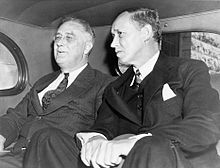
FDR and Hopkins (September 1938)
Considering of the supposition that just one worker per family would be permitted to work under the proposed program, this total of five.15 million was further reduced by one.half-dozen million—the estimated number of workers who were members of families with 2 or more employable people. Thus, there remained a net total of 3.55 million workers in as many households for whom jobs were to be provided.[21] : 562
The WPA reached its peak employment of iii,334,594 people in November 1938.[19] : 547 To be eligible for WPA employment, an private had to exist an American citizen, 18 or older, athletic, unemployed, and certified as in need past a local public relief agency approved past the WPA. The WPA Sectionalization of Employment selected the worker's placement to WPA projects based on previous feel or training. Worker pay was based on three factors: the region of the country, the degree of urbanization, and the individual'south skill. Information technology varied from $19 per month to $94 per month, with the boilerplate wage being most $52.50—$1,011 in nowadays-day terms.[20] [22] The goal was to pay the local prevailing wage, simply limit the hours of work to 8 hours a twenty-four hours or 40 hours a calendar week; the stated minimum being thirty hours a calendar week, or 120 hours a month.[21] : 213
Projects [edit]
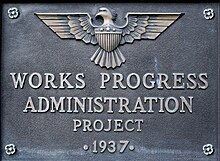
Typical plaque on a WPA projection
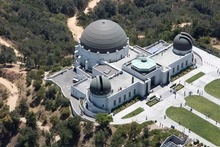
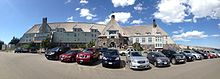
WPA projects were administered by the Partition of Engineering and Construction and the Partitioning of Professional and Service Projects. Most projects were initiated, planned and sponsored past states, counties or cities. Nationwide projects were sponsored until 1939.[23]
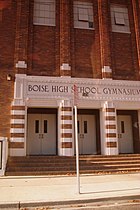
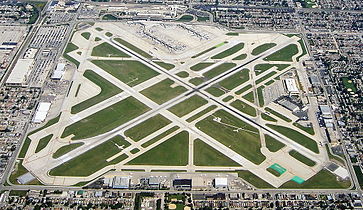
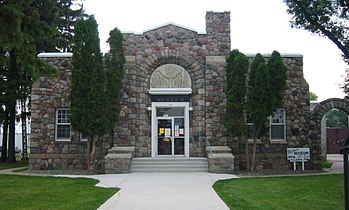
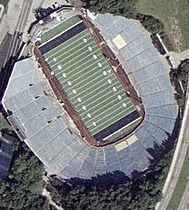
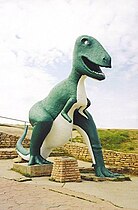
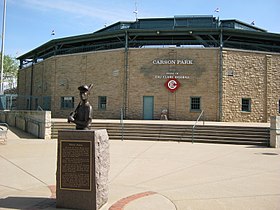
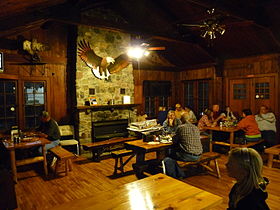
The WPA built traditional infrastructure of the New Deal such as roads, bridges, schools, libraries, courthouses, hospitals, sidewalks, waterworks, and postal service-offices, just besides synthetic museums, swimming pools, parks, community centers, playgrounds, coliseums, markets, fairgrounds, lawn tennis courts, zoos, botanical gardens, auditoriums, waterfronts, city halls, gyms, and university unions. Well-nigh of these are still in employ today.[six] : 226 The corporeality of infrastructure projects of the WPA included 40,000 new and 85,000 improved buildings. These new buildings included five,900 new schools; 9,300 new auditoriums, gyms, and recreational buildings; 1,000 new libraries; vii,000 new dormitories; and 900 new armories. In add-on, infrastructure projects included 2,302 stadiums, grandstands, and bleachers; 52 fairgrounds and rodeo grounds; one,686 parks roofing 75,152 acres; 3,185 playgrounds; 3,026 athletic fields; 805 swimming pools; ane,817 handball courts; x,070 lawn tennis courts; 2,261 horseshoe pits; 1,101 ice-skating areas; 138 outdoor theatres; 254 golf courses; and 65 ski jumps.[half dozen] : 227 Total expenditures on WPA projects through June 1941 totaled approximately $11.4 billion—the equivalent of $210 billion today.[20] Over $4 billion was spent on highway, road, and street projects; more than $1 billion on public buildings, including the iconic Dock Street Theatre in Charleston, the Griffith Observatory in Los Angeles, and Timberline Gild in Oregon'due south Mountain Hood National Forest.[24] : 252–253
More than than $ane billion—$eighteen.4 billion today[20]—was spent on publicly owned or operated utilities; and another $one billion on welfare projects, including sewing projects for women, the distribution of surplus commodities, and school dejeuner projects.[21] : 129 1 construction project was the Merritt Parkway in Connecticut, the bridges of which were each designed every bit architecturally unique.[25] In its eight-year run, the WPA built 325 firehouses and renovated 2,384 of them across the United States. The 20,000 miles of water mains, installed by their hand as well, contributed to increased fire protection across the country.[5] : 69
The direct focus of the WPA projects changed with need. In 1935 priority projects were to improve infrastructure; roads, extension of electricity to rural areas, water conservation, sanitation and inundation command. In 1936, as outlined in that year'southward Emergency Relief Appropriations Deed, public facilities became a focus; parks and associated facilities, public buildings, utilities, airports, and transportation projects were funded. The following twelvemonth, saw the introduction of agricultural improvements, such every bit the production of marl fertilizer and the eradication of mucus pests. Equally the 2d Earth War approached, and then eventually began, WPA projects became increasingly defense related.[five] : 70
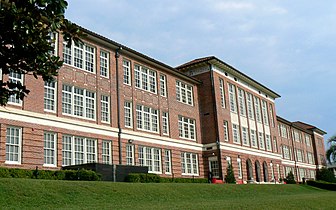
One project of the WPA was funding state-level library service sit-in projects, to create new areas of library service to underserved populations and to extend rural service.[26] Another project was the Household Service Demonstration Project, which trained 30,000 women for domestic employment. South Carolina had one of the larger statewide library service demonstration projects. At the end of the projection in 1943, Due south Carolina had twelve publicly funded county libraries, one regional library, and a funded land library agency.[27]
Federal Project Number 1 [edit]
A meaning aspect of the Works Progress Assistants was the Federal Project Number One, which had five different parts: the Federal Fine art Projection, the Federal Music Project, the Federal Theatre Projection, the Federal Writers' Project, and the Historical Records Survey. The government wanted to provide new federal cultural support instead of simply providing direct grants to private institutions. After simply 1 year, over 40,000 artists and other talented workers had been employed through this project in the The states.[28] Cedric Larson stated that "The touch made by the five major cultural projects of the WPA upon the national consciousness is probably greater in full than anyone readily realizes. Every bit channels of communication between the assistants and the country at big, both direct and indirectly, the importance of these projects cannot be overestimated, for they all behave a tremendous appeal to the heart, the ear, or the intellect—or all three."[29] : 491
Federal Art Project [edit]
This project was directed past Holger Cahill, and in 1936 employment peaked at over 5,300 artists. The Arts Service Division created illustrations and posters for the WPA writers, musicians, and theaters. The Exhibition Sectionalization had public exhibitions of artwork from the WPA, and artists from the Art Pedagogy Division were employed in settlement houses and customs centers to requite classes to an estimated fifty,000 children and adults. They prepare over 100 art centers around the state that served an estimated eight million individuals.[28]
Federal Music Projection [edit]

Directed by Nikolai Sokoloff, sometime primary usher of the Cleveland Orchestra, the Federal Music Project employed over sixteen,000 musicians at its peak. Its purpose was to create jobs for unemployed musicians, It established new ensembles such every bit bedchamber groups, orchestras, choral units, opera units, concert bands, military bands, trip the light fantastic bands, and theater orchestras. They gave 131,000 performances and programs to 92 million people each week.[28] The Federal Music Project performed plays and dances, as well as radio dramas.[29] : 494 In addition, the Federal Music Project gave music classes to an estimated 132,000 children and adults every week, recorded folk music, served as copyists, arrangers, and librarians to aggrandize the availability of music, and experimented in music therapy.[28] Sokoloff stated, "Music can serve no useful purpose unless information technology is heard, but these totals on the listeners' side are more than eloquent than statistics every bit they prove that in this country there is a great hunger and eagerness for music."[29] : 494
Federal Theatre Projection [edit]
In 1929 Broadway alone had employed upwardly of 25,000 workers, onstage and backstage; in 1933, but iv thousand still had jobs. The Actors' Dinner Club and the Actors' Edification Association were giving out free meals every mean solar day. Every theatrical district in the country suffered as audiences dwindled. The New Deal projection was directed by playwright Hallie Flanagan, and employed 12,700 performers and staff at its elevation. They presented more than 1,000 performances each month to almost one million people, produced 1,200 plays in the four years information technology was established, and introduced 100 new playwrights. Many performers later became successful in Hollywood including Orson Welles, John Houseman, Burt Lancaster, Joseph Cotten, Canada Lee, Will Geer, Joseph Losey, Virgil Thomson, Nicholas Ray, E.G. Marshall and Sidney Lumet. The Federal Theatre Projection was the first project to cease; it was terminated in June 1939 afterwards Congress zeroed out the funding.[28] [30]
Federal Writers' Project [edit]
This project was directed past Henry Alsberg and employed 6,686 writers at its peak in 1936.[28] By January 1939, more than 275 major books and booklets had been published by the FWP.[29] : 494 Most famously, the FWP created the American Guide Series, which produced thorough guidebooks for every state that include descriptions of towns, waterways, historic sites, oral histories, photographs, and artwork.[28] An association or grouping that put up the cost of publication sponsored each book, the price was anywhere from $5,000 to $x,000. In about all cases, the volume sales were able to reimburse their sponsors.[29] : 494 Additionally, another of import part of this project was to tape oral histories to create archives such every bit the Slave Narratives and collections of folklore. These writers also participated in research and editorial services to other government agencies.[28]
Historical Records Survey [edit]
This project was the smallest of Federal Project Number 1 and served to identify, collect, and conserve United States' historical records.[28] It is one of the biggest bibliographical efforts and was directed by Dr. Luther H. Evans. At its peak, this project employed more iv,400 workers.[29] : 494
-
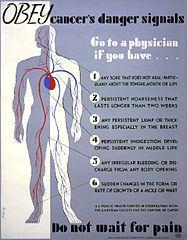
WPA wellness education poster well-nigh cancer, c. 1936–1938
-

Affiche for the WPA shows various items that can exist purchased at the 5 & 10¢ store
-

WPA poster advertising art classes for children
-

WPA poster promoting the zoo equally a identify to visit, showing an elephant
-
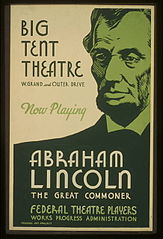
1936 WPA Poster for Federal Theatre Project presentation
-

WPA affiche encouraging laborers to piece of work for America
Library Services Programme [edit]
Earlier the Bang-up Depression, it was estimated that i/3 of the population in the Usa did non have reasonable access to public library services.[31] Understanding the need, non only to maintain existing facilities only to expand library services led to the establishment of the WPA's Library Projects. With the onset of the Low local governments facing failing revenues were unable to maintain social services, including libraries. This lack of acquirement exacerbated problems of library access that were already widespread. In 1934 only two states, Massachusetts and Delaware, provided their total population access to public libraries.[32] In many rural areas, there were no libraries, and where they did exist, reading opportunities were minimal. 66% of the South's population did not have access to whatever public library. Libraries that existed circulated i book per capita.[33] The early emphasis of these programs was on extending library services to rural populations, by creating libraries in areas that lacked facilities. The WPA library program also profoundly augmented reader services in metropolitan and urban centers.
By 1938 the WPA Library Services Project had established 2300 new libraries, 3400 reading rooms in existing libraries, and 53 traveling libraries for sparsely settled areas.[1] Federal money for these projects could only be spent on worker wages, therefore local municipalities would take to provide upkeep on properties and purchase equipment and materials. At the local level, WPA libraries relied on funding from county or city officials or funds raised by local community organizations such as women's clubs. Due to limited funding many WPA libraries were "little more than book distribution stations: tables of materials under temporary tents, a tenant home to which nearby readers came for their books, a school superintendents' abode, or a crossroads general store."[34] The public response to the WPA libraries was extremely positive. For many "the WPA had go 'the breadline of the spirit.'"[35]
At its acme in 1938 38,324 people, primarily women, were employed in library services programs. 25,625 were employed in library services and 12,696 in bookbinding and repair.
Considering book repair was an activity that could be taught to unskilled workers and in one case trained, could exist conducted with little supervision, repair and mending became the main activity of the WPA Library Project. The basic rationale for this change was that the mending and repair projects saved public libraries and school libraries thousands of dollars in conquering costs while employing needy women who were ofttimes heads of households.[36]
Past 1940 the WPA Library Project, now the Library Services Plan, began to shift its focus every bit the entire WPA began to move operations towards goals of national defense. WPA Library Programs served those goals in ii ways: one- existing WPA libraries could distribute materials to the public on the nature of an imminent national defence emergency and the need for national defence force training. 2- the projection could provide supplementary library services to military camps and defense impacted communities.
By December 1941 the number of people employed in WPA library piece of work was only 16,717. In May of the following twelvemonth, all statewide Library Projects were reorganized as WPA State of war Information Services Programs. By early 1943 the work of endmost war information centers had begun. The concluding calendar week of service for remaining WPA library workers was March 15, 1943.[37]
While information technology is hard to quantify the success or failure of WPA Library Projects relative to other WPA programs, "what is incontestable is the fact that the library projects provided much-needed employment for by and large female workers, recruited many to librarianship in at least semiprofessional jobs, and retained librarians who may have left the profession for other work had employment not come up through federal relief...the WPA subsidized several new ventures in readership services such as the widespread use of bookmobiles and supervised reading rooms-services that became permanent in post-low and postwar American libraries."[38]
In extending library services to people who lost their libraries or never had a library, to begin with, WPA Library Services Projects achieved astounding success, made meaning permanent gains, and had a profound bear upon on library life in America.
African Americans [edit]
The share of Federal Emergency Relief Administration and WPA benefits for African Americans exceeded their proportion of the full general population. The FERA's first relief demography reported that more than than ii million African Americans were on relief during early 1933, a proportion of the African-American population (17.8%) that was nearly double the proportion of whites on relief (nine.five%).[39] This was during the catamenia of Jim Crow and racial segregation in the Due south, when blacks were largely disenfranchised.
By 1935, at that place were 3,500,000 African Americans (men, women and children) on relief, virtually 35 percent of the African-American population; plus another 250,000 African-American adults were working on WPA projects. Altogether during 1938, virtually 45 percentage of the nation'due south African-American families were either on relief or were employed past the WPA.[39]
Ceremonious rights leaders initially objected that African Americans were proportionally underrepresented. African American leaders made such a claim with respect to WPA hires in New Jersey, stating, "In spite of the fact that Blacks indubitably constitute more 20 pct of the State's unemployed, they equanimous 15.9% of those assigned to West.P.A. jobs during 1937."[21] : 287 Nationwide in 1940, nine.8% of the population were African American.
However, by 1941, the perception of discrimination against African Americans had changed to the betoken that the NAACP magazine Opportunity hailed the WPA:
It is to the eternal credit of the administrative officers of the WPA that discrimination on various projects considering of race has been kept to a minimum and that in near every community Negroes have been given a chance to participate in the work program. In the South, as might have been expected, this participation has been limited, and differential wages on the basis of race accept been more than or less finer established; but in the northern communities, particularly in the urban centers, the Negro has been afforded his offset existent opportunity for employment in white-neckband occupations.[21] : 295
The WPA mostly operated segregated units, every bit did its youth affiliate, the National Youth Administration.[twoscore] Blacks were hired by the WPA every bit supervisors in the Due north; nevertheless of 10,000 WPA supervisors in the South, simply eleven were blackness.[41] Historian Anthony Badger argues, "New Bargain programs in the South routinely discriminated against blacks and perpetuated segregation."[42]
People with physical disabilities [edit]
The League of the Physically Handicapped in New York was organized in May 1935 to end discrimination by the WPA against the physically handicapped unemployed.[43] The city's Abode Relief Bureau coded applications by the physically handicapped applicants every bit "PH" ("physically handicapped"). Thus they were not hired by the WPA.[44] In protest the League held two sit-ins in 1935.[44] [45] The WPA relented and created ane,500 jobs for physically handicapped workers in New York Metropolis.[46] [47] [48]
Women [edit]
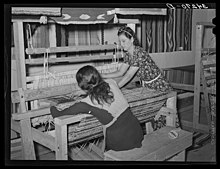
Women in Costilla, New Mexico, weaving rag rugs in 1939
About 15% of the household heads on relief were women, and youth programs were operated separately by the National Youth Assistants. The average worker was well-nigh 40 years old (about the same equally the average family unit head on relief).
WPA policies were consistent with the strong conventionalities of the fourth dimension that husbands and wives should not both exist working (considering the second person working would take ane job abroad from some other breadwinner). A written report of 2,000 female workers in Philadelphia showed that 90% were married, only wives were reported as living with their husbands in simply eighteen percentage of the cases. But ii percent of the husbands had private employment. Of the 2,000 women, all were responsible for one to five additional people in the household.[21] : 283
In rural Missouri, 60% of the WPA-employed women were without husbands (12% were single; 25% widowed; and 23% divorced, separated or deserted). Thus, only twoscore% were married and living with their husbands, but 59% of the husbands were permanently disabled, 17% were temporarily disabled, 13% were too onetime to piece of work, and remaining x% were either unemployed or handicapped. Most of the women worked with sewing projects, where they were taught to utilise sewing machines and made article of clothing and bedding, equally well as supplies for hospitals, orphanages, and adoption centers.[21] : 283 [49]
One WPA-funded project, the Pack Horse Library Project, mainly employed women to deliver books to rural areas in eastern Kentucky.[50] Many of the women employed by the project were the sole breadwinners for their families.[51]
Criticism [edit]
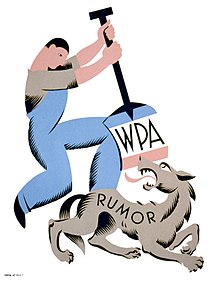
Poster representing the WPA defending itself from attacks
The WPA had numerous critics,[52] The strongest attacks were that it was the prelude for a national political automobile on behalf of Roosevelt. Reformers secured the Hatch Act of 1939 that largely depoliticized the WPA.[53]
Others complained that far left elements played a major role, specially in the New York City unit. Representative J. Parnell Thomas of the House Committee on Un-American Activities claimed in 1938 that divisions of the WPA were a "hotbed of Communists" and "one more link in the vast and unparalleled New Deal propaganda network."[54]
Much of the criticism of the distribution of projects and funding allocation is a event of the view that the decisions were politically motivated. The S, as the poorest region of the United States, received 75 percent less in federal relief and public works funds per capita than the West. Critics would point to the fact that Roosevelt'southward Democrats could be certain of voting support from the S, whereas the West was less of a sure thing; swing states took priority over the other states.[55] : 70
There was a perception that WPA employees were not diligent workers, and that they had little incentive to give upwardly their decorated work in favor of productive jobs. Some employers said that the WPA instilled poor work habits and encouraged inefficiency.[56] Some job applicants found that a WPA work history was viewed negatively by employers, who said they had formed poor work habits.[57]
A Senate commission reported that, "To some extent the complaint that WPA workers do poor work is not without foundation. ... Poor work habits and incorrect techniques are non remedied. Occasionally a supervisor or a foreman demands good work."[58] The WPA and its workers were ridiculed equally being lazy. The arrangement's initials were said to correspond "We Poke Along" or "We Putter Forth" or "Nosotros Piddle Effectually" or "Whistle, Piss and Argue." These were sarcastic references to WPA projects that sometimes slowed downward deliberately because foremen had an incentive to keep going, rather than stop a projection.[59]
The WPA's Sectionalisation of Investigation proved so effective in preventing political corruption "that a afterward congressional investigation couldn't find a unmarried serious irregularity it had overlooked," wrote economist Paul Krugman. "This dedication to honest government wasn't a sign of Roosevelt's personal virtue; rather, it reflected a political imperative. FDR's mission in part was to show that government activism works. To maintain that mission's credibility he needed to keep his administration's tape clean. And he did."[sixty]
Many complaints were recorded from private industry at the time that the beingness of WPA works programs made hiring new workers hard. The WPA claimed to counter this by keeping hourly wages well below private wages and encouraging relief workers to actively seek private employment and accept job offers if they got them.[4] : 196
Evolution [edit]
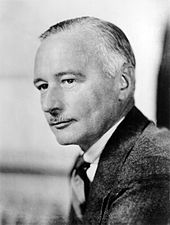
On December 23, 1938, after leading the WPA for 3.5 years, Harry Hopkins resigned and became the Secretarial assistant of Commerce. To succeed him Roosevelt appointed Francis C. Harrington, a colonel in the Regular army Corps of Engineers and the WPA'south chief engineer, who had been leading the Division of Engineering and Construction.[19] : 417–420
Following the passage of the Reorganization Human activity of 1939 in Apr 1939, the WPA was grouped with the Agency of Public Roads, Public Buildings Co-operative of the Procurement Division, Branch of Buildings Direction of the National Park Service, United States Housing Authority and the Public Works Administration under the newly created Federal Works Agency. Created at the aforementioned time, the Federal Security Agency assumed the WPA'south responsibility for the National Youth Administration. "The proper noun of the Works Progress Administration has been changed to Work Projects Assistants in order to make its championship more descriptive of its major purpose," President Roosevelt wrote when announcing the reorganization.[61]
Equally WPA projects became more field of study to the state, local sponsors were called on to provide 25% of project costs. As the number of public works projects slowly diminished, more projects were dedicated to preparing for war.[6] : 227 Having languished since the end of World War I, the American armed services services were depopulated and served past crumbling facilities; when Frg occupied Czechoslovakia in 1938, the U.S. Army numbered but 176,000 soldiers.[19] : 494
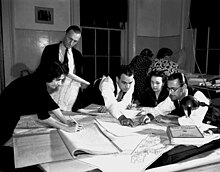
WPA researchers and map makers prepare the air raid warning map for New Orleans within days of the attack on Pearl Harbor (December xi, 1941)
On May 26, 1940, FDR delivered a fireside conversation to the American people about "the approaching storm",[62] and on June six Harrington reprioritized WPA projects, anticipating a major expansion of the U.Due south. military. "Types of WPA work to exist expedited in every possible fashion to include, in add-on to airports and military airfields, construction of housing and other facilities for enlarged war machine garrisons, camp and cantonment structure, and various improvements in navy yards," Harrington said. He observed that the WPA had already fabricated substantial contributions to national defense over its five years of beingness, by building 85 percent of the new airports in the U.S. and making $420 meg in improvements to military machine facilities. He predicted there would exist 500,000 WPA workers on defence-related projects over the adjacent 12 months, at a cost of $250 million.[19] : 492–493 The estimated number of WPA workers needed for defense projects was presently revised to between 600,000 and 700,000. Vocational preparation for war industries was also begun by the WPA, with fifty,000 trainees in the programme by Oct 1940.[xix] : 494
"Only the WPA, having employed millions of relief workers for more than 5 years, had a comprehensive awareness of the skills that would exist available in a full-calibration national emergency," wrote journalist Nick Taylor. "As the country began its preparedness buildup, the WPA was uniquely positioned to become a major defense agency."[19] : 494–495
Harrington died suddenly, aged 53, on September thirty, 1940. Notably apolitical—he boasted that he had never voted[63]—he had deflected Congressional criticism of the WPA by bringing attention to its building accomplishments and its role every bit an employer.[19] : 504 Harrington'due south successor, Howard O. Hunter, served as caput of the WPA until May i, 1942.[19] : 517
Termination [edit]
Unemployment ended with war production for Globe State of war Ii, as millions of men joined the services, and cost-plus contracts made it attractive for companies to rent unemployed men and railroad train them.[19] [ page needed ] [28]
Concluding that a national relief program was no longer needed, Roosevelt directed the Federal Works Ambassador to stop the WPA in a letter of the alphabet December 4, 1942. "Seven years ago I was convinced that providing useful work is superior to whatever and every kind of dole. Experience had amply justified this policy," FDR wrote:
By building airports, schools, highways, and parks; by making huge quantities of habiliment for the unfortunate; by serving millions of lunches to school children; by almost immeasurable kinds and quantities of service the Work Projects Administration has reached a artistic hand into every county in this Nation. It has added to the national wealth, has repaired the wastage of depression, and has strengthened the land to bear the burden of war. By employing eight millions of Americans, with xxx millions of dependents, it has brought to these people renewed promise and courage. It has maintained and increased their working skills; and it has enabled them one time more to take their rightful places in public or in private employment.[64]
Roosevelt ordered a prompt end to WPA activities to conserve funds that had been appropriated. Operations in most states concluded February 1, 1943. With no funds budgeted for the next fiscal year, the WPA ceased to be after June xxx, 1943.[64]
Legacy [edit]
"The agencies of the Franklin D. Roosevelt administration had an enormous and largely unrecognized role in defining the public space nosotros now utilise", wrote sociologist Robert D. Leighninger. "In a brusque period of 10 years, the Public Works Assistants, the Works Progress Administration, and the Noncombatant Conservation Corps congenital facilities in practically every community in the country. Nigh are still providing service half a century later on. It is time we recognized this legacy and attempted to comprehend its relationship to our contemporary state of affairs."[6] : 226













Meet also [edit]
- American Guide Serial
- Federal Art Project
- Federal Project Number Ane
- Hatch Human activity of 1939
- List of Federal Art Project artists
- Presidency of Franklin D. Roosevelt
- Public Works of Art Projection
- Section of Painting and Sculpture, in Treasury department
References [edit]
- ^ a b Arnesen, Eric (2007). Encyclopedia of U.S. Labor and Working-Class History. Vol. 1. New York: Routledge. p. 1540. ISBN9780415968263.
- ^ Smith, Jason Scott (2006). Building New Deal Liberalism: The Political Economy of Public Works, 1933–1956. New York: Cambridge Academy Press. p. 87. ISBN9780521828055.
- ^ "WPA Pays Upwards and Quits". The New York Times. July 1, 1943. Retrieved 2016-02-24 .
- ^ a b Neumann, Todd C. (2010). "The Dynamics of Relief Spending and the Individual Urban Labor Market During the New Bargain" (PDF). The Periodical of Economic History. 70 (one): 195–220. doi:x.1017/S0022050710000100. S2CID 154809769.
- ^ a b c d e Leighninger, Robert D. (2007). Long-Range Public Investment: The Forgotten Legacy of the New Deal. Columbia, S.C.: University of South Carolina Press. ISBN9781570036637.
- ^ a b c d e Leighninger, Robert D. (May 1996). "Cultural Infrastructure: The Legacy of New Deal Public Space". Journal of Architectural Education. 49 (4): 226–236. doi:10.1080/10464883.1996.10734689. JSTOR 1425295.
- ^ "Records of the Work Projects Administration and Its Predecessors". Records of the Piece of work Projects Administration (WPA). National Archives and Records Administration. Retrieved 2016-02-28 .
- ^ Roosevelt, Franklin D. (May 6, 1935). "Executive Gild 7034 – Creating Machinery for the Works Progress Administration". The American Presidency Project. Online past Gerhard Peters and John T. Woolley. Retrieved 2016-02-27 .
- ^ Deeben, John P. (Fall 2012). "Family Experiences and New Bargain Relief: The Correspondence Files of the Federal Emergency Relief Administration, 1933–1936". Prologue Magazine. Vol. 44, no. 2. National Archives and Records Administration. Retrieved 2016-02-27 .
- ^ Flanagan, Hallie (1965). Arena: The History of the Federal Theatre. New York: Benjamin Blom, reprint edition [1940]. OCLC 855945294.
- ^ "Records of the Partitioning of Engineering and Structure". Records of the Work Projects Administration (WPA). National Athenaeum and Records Administration. Retrieved 2016-02-27 .
- ^ "Records of the Division of Professional and Service Projects". Records of the Piece of work Projects Administration (WPA). National Archives and Records Administration. Retrieved 2016-02-27 .
- ^ "Records of the Sectionalization of Finance". Records of the Piece of work Projects Administration (WPA). National Archives and Records Assistants. Retrieved 2016-02-27 .
- ^ "Records of the Division of Information". Records of the Work Projects Assistants (WPA). National Archives and Records Administration. Retrieved 2016-02-27 .
- ^ "Records of the Segmentation of Investigation". Records of the Piece of work Projects Assistants (WPA). National Archives and Records Administration. Retrieved 2016-02-27 .
- ^ "Records of the Division of Statistics". Records of the Work Projects Administration (WPA). National Archives and Records Administration. Retrieved 2016-02-27 .
- ^ "Records of the Project Control Divisions". Records of the Work Projects Administration (WPA). National Archives and Records Assistants. Retrieved 2016-02-27 .
- ^ "Records of Other WPA Divisions". Records of the Work Projects Administration (WPA). National Archives and Records Administration. Retrieved 2016-02-27 .
- ^ a b c d e f yard h i j Taylor, Nick (2008). American-Fabricated: The Enduring Legacy of the WPA, When FDR Put the Nation to Work. New York: Bantam Books. ISBN9780553802351.
- ^ a b c d east 1634–1699: McCusker, J. J. (1997). How Much Is That in Real Money? A Historical Price Alphabetize for Apply equally a Deflator of Money Values in the Economic system of the United States: Addenda et Corrigenda (PDF). American Antiquarian Society. 1700–1799: McCusker, J. J. (1992). How Much Is That in Real Money? A Historical Price Index for Apply as a Deflator of Coin Values in the Economy of the United States (PDF). American Antique Gild. 1800–present: Federal Reserve Bank of Minneapolis. "Consumer Toll Index (estimate) 1800–". Retrieved April 16, 2022.
- ^ a b c d e f k h i Howard, Donald S. (1973) [1943]. The WPA and Federal Relief Policy. New York: Da Capo Printing. OCLC 255072517.
- ^ "WPA Employment." Gjenvick Athenaeum: The Future of Our Past, Social and Cultural History. (2000)
- ^ "Records of WPA Projects". Records of the Piece of work Projects Assistants (WPA). National Archives and Records Administration. Retrieved 2016-02-25 .
- ^ Kennedy, David Thou. (1999). Liberty from Fear: The American People in Low and War, 1929–1945. New York: Oxford University Press. ISBN9780195038347.
- ^ "Website on Merritt Parkway Bridges". By-inc.org. Retrieved 2012-04-20 .
- ^ "WPA and Rural Libraries". Newdeal.feri.org. Archived from the original on 1999-10-02. Retrieved 2012-04-twenty .
- ^ "Blazing the Fashion: The WPA Library Service Demonstration Projection in Southward Carolina by Robert M. Gorman" (PDF). Archived from the original (PDF) on 2012-04-15. Retrieved 2012-04-20 .
- ^ a b c d e f thou h i j Adams, Don; Goldbard, Arlene (1995). "New Deal Cultural Programs: Experiments in Cultural Democracy". Webster'southward World of Cultural Republic . Retrieved 2016-02-24 .
- ^ a b c d e f Larson, Cedric (July 1939). "The Cultural Projects of the WPA". Public Opinion Quarterly. three (3): 491–496. doi:10.1086/265324. JSTOR 2744973.
- ^ Susan Quinn, The Furious Improvisation: How the WPA and a Bandage of Thousands Made High Art out of Desperate Times (2008) pp. 62, 280.
- ^ "Library". MRS Bulletin. xx (12): 52–53. December 1995. doi:ten.1557/s0883769400045929. ISSN 0883-7694.
- ^ Swain, Martha H. (1995). "A New Bargain in Libraries: Federal Relief Work and Library Service, 1933-1943". Libraries & Culture. xxx (iii): 265–283. ISSN 0894-8631. JSTOR 25542771.
- ^ Young man, Martha H. (1995). "A New Deal in Libraries: Federal Relief Piece of work and Library Service, 1933-1943". Libraries & Culture. 30 (3): 265–283. ISSN 0894-8631. JSTOR 25542771.
- ^ Young man, Martha H. (1995). "A New Deal in Libraries: Federal Relief Work and Library Service, 1933-1943". Libraries & Culture. 30 (iii): 265–283. ISSN 0894-8631. JSTOR 25542771.
- ^ Swain, Martha H. (1995). "A New Bargain in Libraries: Federal Relief Work and Library Service, 1933-1943". Libraries & Culture. xxx (three): 265–283. ISSN 0894-8631. JSTOR 25542771.
- ^ Swain, Martha H. (1995). "A New Deal in Libraries: Federal Relief Work and Library Service, 1933-1943". Libraries & Culture. 30 (3): 265–283. ISSN 0894-8631. JSTOR 25542771.
- ^ Boyfriend, Martha H. (1995). "A New Deal in Libraries: Federal Relief Work and Library Service, 1933-1943". Libraries & Culture. 30 (three): 265–283. ISSN 0894-8631. JSTOR 25542771.
- ^ Fellow, Martha H. (1995). "A New Deal in Libraries: Federal Relief Work and Library Service, 1933-1943". Libraries & Civilization. thirty (three): 265–283. ISSN 0894-8631. JSTOR 25542771.
- ^ a b John Salmond, "The New Deal and the Negro" in John Braeman et al., eds. The New Deal: The National Level (1975). pp 188–89
- ^ Charles L. Lumpkins (2008). American Pogrom: The East St. Louis Race Riot and Blackness Politics. Ohio University Press. p. 179. ISBN9780821418031.
- ^ Cheryl Lynn Greenberg (2009). To Ask for an Equal Chance: African Americans in the Great Depression. Rowman & Littlefield. p. sixty. ISBN9781442200517.
- ^ Anthony J. Badger (2011). New Deal / New Due south: An Anthony J. Annoy Reader. U. of Arkansas Press. p. 38. ISBN9781610752770.
- ^ Longmore, PK; Goldberger, David (December 2000). "The League of the Physically Handicapped and the Smashing Depression: A Example Study in the New Disability History". The Journal of American History. 87 (3): 888–922. doi:ten.2307/2675276. JSTOR 2675276. PMID 17639642.
- ^ a b Rosenthal, Keith. "Pioneers in the fight for disability rights The League of the Physically Handicapped". International Socialist Review . Retrieved 29 April 2018.
- ^ "PLEA BY DISABLED PUT TO WPA CHIEF; New York Group, Camping in Washington, Will Consult Williams Once more Today". August 17, 1937. Retrieved 29 April 2018.
- ^ Fleischer, Doris Zames; Zames, Frieda (2001). The Disability Rights Movement: From Charity to Confrontation . Philadelphia: Temple University Press. p. 906. ISBN1439907447.
- ^ "Disability History Timeline". Rehabilitation Enquiry & Training Center on Independent Living Management. Temple Academy. Archived from the original on 20 December 2013. Retrieved 23 January 2017.
- ^ Longmore, PK (January 2000). "Disability Policy and Politics: Considering Consumer Influence". Periodical of Disability Policy Studies. xi (1): 36–44. doi:10.1177/104420730001100111. S2CID 145123577.
- ^ Dickens, Bethany (November 18, 2014). "Episode 32 Tapestries". A History of Fundamental Florida Podcast . Retrieved Jan thirty, 2016.
- ^ "The Pack Equus caballus Librarians of Eastern Kentucky". Horse Canada . Retrieved 2017-09-01 .
- ^ Boyd, Donald C. (2007). "The Book Women of Kentucky: The WPA Pack Horse Library Project, 1936–1943". Libraries & the Cultural Record. 42 (2): 120 – via Project MUSE.
- ^ Howard, Donald S. (1943). "The WPA and Federal Relief Policy". The University of Chicago Press. 17 (four): 509–510. JSTOR 30014174.
- ^ Alexander Keyssar, The right to vote: the contested history of republic in the Usa (2000) p 193
- ^ Gina Misiroglu, ed. (2015). American Countercultures: An Encyclopedia of Nonconformists, Culling Lifestyles, and Radical Ideas in U.Due south. History. Routledge. p. 334. ISBN9781317477297.
- ^ Lee, Bradford A. (Spring 1982). "The New Deal Reconsidered". The Wilson Quarterly. half-dozen (2): 62–76. JSTOR 40256265.
- ^ Ginzberg, Eli (2004) [1943]. The Unemployed. New Brunswick: Transaction Publishers. p. 447. ISBN9780765805744.
- ^ Wood, Margaret Mary (1953). Paths of Loneliness: The Individual Isolated in Modern Social club. New York: Columbia University Printing. p. 61. OCLC 620533.
- ^ Report of investigation of public relief in the Commune of Columbia (U.S. Senate), (1938)
- ^ David A. Taylor, Soul of a people: the WPA Writer's Project uncovers Low America (2009) p 12
- ^ Krugman, Paul (2007). The Conscience of a Liberal. New York: W. W. Norton & Company. p. 62. ISBN9780393060690.
- ^ Roosevelt, Franklin D. (April xv, 1939). "Bulletin to Congress on the Reorganization Deed". The American Presidency Projection. Online by Gerhard Peters and John T. Woolley. Retrieved 2015-06-29 .
- ^ Roosevelt, Franklin D. "Fireside Chat 15: On National Defence (May 26, 1940)". Miller Center of Public Diplomacy, Academy of Virginia. Retrieved 2016-02-25 .
- ^ Associated Press (October 1, 1940). "WPA Head Dies in Connecticut". Chicago Tribune . Retrieved 2016-02-25 .
- ^ a b Roosevelt, Franklin D. (December 4, 1942). "Letter to the Federal Works Administrator Discontinuing the Westward.P.A." The American Presidency Project. Online by Gerhard Peters and John T. Woolley. Retrieved 2021-04-10 .
Farther reading [edit]
- Adams, Don; Goldbard, Arlene. "New Deal Cultural Programs: Experiments in Cultural Commonwealth." Webster'due south World of Cultural Democracy 1995.
- Halfmann, Drew, and Edwin Amenta. "Who voted with Hopkins? Institutional politics and the WPA." Journal of Policy History xiii#2 (2001): 251–287. online
- Hopkins, June. "The Road Non Taken: Harry Hopkins and New Deal Work Relief" Presidential Studies Quarterly 29#2 (1999): 306–16 online
- Howard, Donald Due south. WPA and federal relief policy (1943), 880pp; highly detailed report by the contained Russell Sage Foundation.
- Kelly, Andrew, Kentucky by Design: The Decorative Arts, American Civilisation and the Arts Programs of the WPA. Lexington: University Press of Kentucky. 2015.
- Larson, Cedric. "The Cultural Projects of the WPA." The Public Opinion Quarterly 3#iii (1939): 491–196. Accessed in JSTOR
- Leighninger, Robert D. "Cultural Infrastructure: The Legacy of New Deal Public Space." Journal of Architectural Educational activity 49, no. four (1996): 226–236.
- Leighninger, Robert D., Jr. Long-Range Public Investment: the Forgotten Legacy of the New Bargain. Columbia, S.C.: Academy of South Carolina Printing (2007).
- Lindley, Betty Grimes & Lindley, Ernest K. A New Deal for Youth: the Story of the National Youth Administration (1938)
- McJimsey George T. Harry Hopkins: Ally of the Poor and Defender of Democracy (1987) online
- Mathews, Jane DeHart. Federal Theatre, 1935-1939: Plays, Relief, and Politics (Princeton UP 1967) online
- Meriam; Lewis. Relief and Social Security. 900 pp. Washington, DC: The Brookings Institution, 1946.
- Millett; John D. & Gladys Ogden. Administration of Federal Work Relief 1941.
- Musher, Sharon Ann. Democratic Fine art: The New Deal'due south Influence on American Civilization. Chicago: University of Chicago Printing, 2015.
- Rose, Nancy. The WPA and Public Employment in the Keen Depression (2009)
- Sargent, James E. "Woodrum'due south Economy Bloc: The Assail on Roosevelt'southward WPA, 1937–1939." Virginia Mag of History and Biography (1985): 175–207. in JSTOR
- Sheppard, Si. Buying of the Presidency?, The: Franklin D. Roosevelt, the New Deal, and the Election of 1936 (ABC-CLIO, 2014).
- Singleton, Jeff. The American Dole: Unemployment Relief and the Welfare State in the Great Depression (2000)
- Smith, Jason Scott. Building New Deal Liberalism: the Political Economy of Public Works, 1933–1956 (2005)
- Taylor, David A. Soul of a People: The WPA Writers' Project Uncovers Depression America. (2009)
- Taylor, Nick. American-Fabricated: The Enduring Legacy of the WPA: When FDR Put the Nation to Piece of work (2008)
- The states Senate. "Report of investigation of public relief in the Commune of Columbia". Washington D.C.: 1938
- Williams, Edward Ainsworth. Federal assistance for relief (1939)
- Young, William H., & Nancy Yard. The Bully Low in America: a Cultural Encyclopedia. 2 vols. Westport, Conn.: Greenwood Press, 2007 ISBN 0-313-33520-6
External links [edit]
- WPA Oral Histories at George Stonemason University
- John C. Kennedy Papers. 1912–1938. 5" linear (circa 80 items).
- Footage of the Federal Theatre Project's 1936 "Voodoo Macbeth" – with informative annotations.
- The Not bad Depression in Washington Country Project, including an illustrated map of major WPA projects and a multimedia history of the Federal Theater Project in the Country.
- The Index of American Blueprint at the National Gallery of Fine art
- Works past Works Progress Assistants at Project Gutenberg
- Works by or about Works Progress Administration at Internet Annal
- Works past Works Progress Assistants at LibriVox (public domain audiobooks)

- Guide to the WPA Oregon Federal Art Project collection at the University of Oregon
- WPA inspired Gulf Declension Borough Works Projection
- An Introduction to the Employer of Last Resort Proposal from Dollars & Sense. Includes several images from the original WPA.
- Living New Deal Project – The Living New Deal Project documents the living legacy of New Deal agencies, including the WPA. The Living New Deal website includes an all-encompassing digital map featuring detailed data nearly specific WPA projects by location.
- New Deal Agencies: The Works Progress Assistants
- Soul of a People documentary on Smithsonian Networks
- Works Progress Administration Tampa Office Records at the Academy of South Florida
- Arizona Archives Online Finding Aid – The Arizona State Museum Library & Athenaeum holds the records of the WPA Statewide Archaeological Project (1938–1940) and are found on AAO.
- WPA Art Inventory Project at the Connecticut State Library
- WPA Omaha, Nebraska City Guide Project by the University of Nebraska Omaha Dr. C.C. and Mabel L. Criss Library.
- WPA publications from Alabama, Florida, Georgia, Kentucky, Louisiana, Maryland, Due north Carolina, and Tennessee housed at the University of Kentucky Libraries Special Collections Research Center
- Tapestries at A History of Central Florida Podcast
- WPA digital collection at the New York Public Library
- WPA Music Manuscripts at Wayne Country Academy Library is a digitization projection that contains 174 images of WPA music copies from 1935 to 1943.
- United States Piece of work Projects Administration Polar Bibliography at Dartmouth College Library
- Work Projects Administration in Maryland records at the Academy of Maryland libraries
- Portrait of WPA chief engineer Ormond A. Rock, Los Angeles, 1935. Los Angeles Times Photographic Archive (Collection 1429). UCLA Library Special Collections, Charles E. Young Research Library, University of California, Los Angeles.
- Portrait of WPA principal of operations, Eltinge T. Brown, Los Angeles, 1935. Los Angeles Times Photographic Annal (Collection 1429). UCLA Library Special Collections, Charles Eastward. Young Enquiry Library, University of California, Los Angeles.
- Portrait of WPA manager R. C. Jacobson, Los Angeles, 1936. Los Angeles Times Photographic Archive (Collection 1429). UCLA Library Special Collections, Charles E. Young Research Library, University of California, Los Angeles.
- Collection: "Art of the Works Progress Assistants WPA" from the University of Michigan Museum of Art
WPA posters:
- Posters from the WPA at the Library of Congress
Libraries and the WPA:
- The WPA Library Project in South Carolina
- Due south Carolina Public Library History, 1930–1945
- WPA Children'due south Books (1935–1943) Broward County Library's Bienes Museum of the Mod Book
WPA murals:
- Database of WPA murals
- WPA-FAP Mural Segmentation in NYC, and restoration of murals at the Williamsburg Houses and Infirmary for Chronic Diseases on Welfare Island
- WPA mural projects past noted muralist Sr. Lucia Wiley
- WPA Artist Louis Schanker
- WPA Creative person Robert Tabor
Source: https://en.wikipedia.org/wiki/Works_Progress_Administration
0 Response to "The Wpa Formed One of the Largest Federal Programs for the Support of the Arts"
Post a Comment